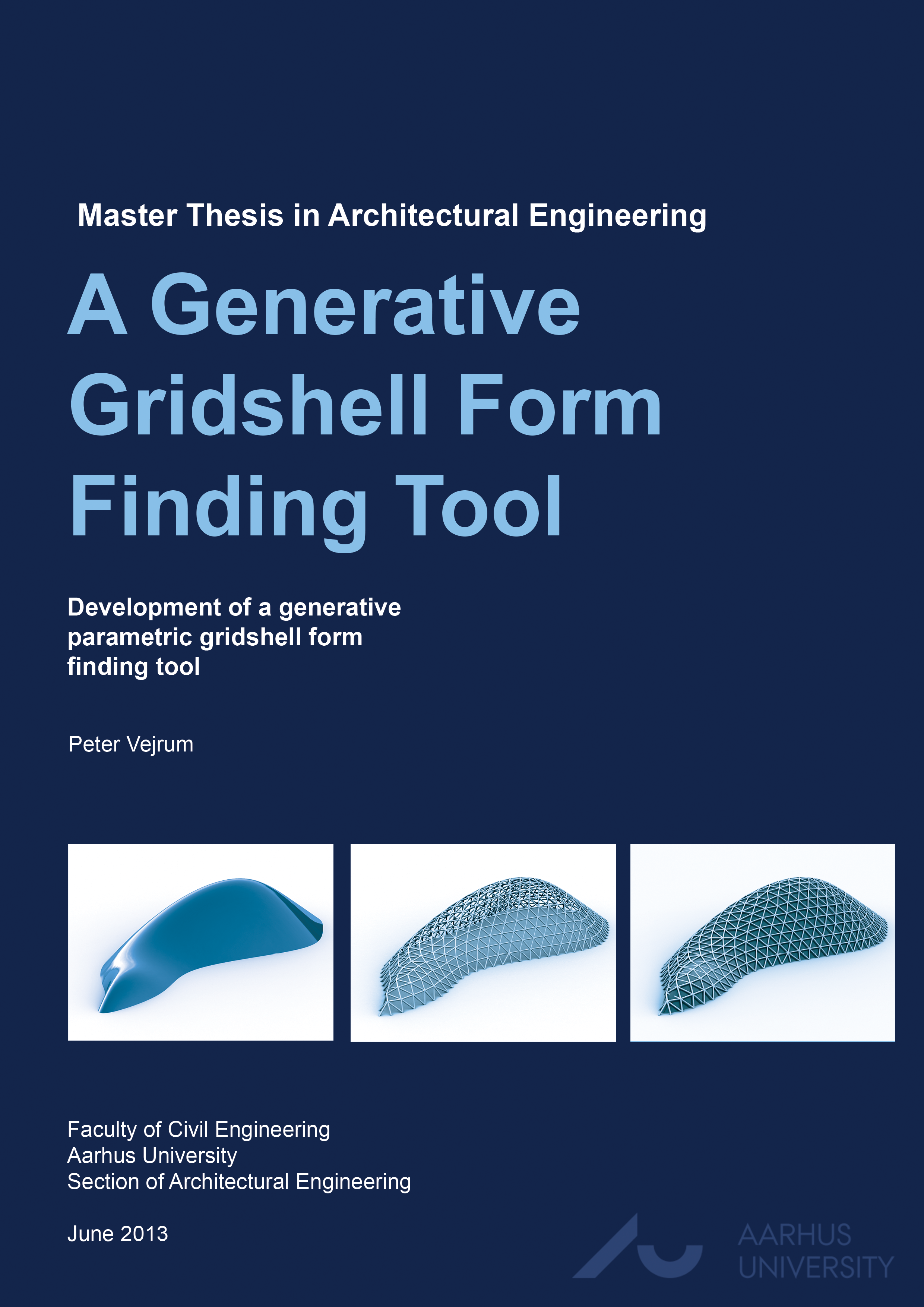
 The following report was written as a result of my thesis project that concludes my Master studies in Architectural Engineering at Aarhus University. In the thesis I have developed and case tested a gridshell form finding tool aimed to aid architects and engineers in the conceptual design phases of a gridshell structure.
The free form gridshell is a complex structure which is why so few have been built. This thesis seeks to change this fact by presenting a software tool capable of generating and optimizing the complex geometry of a gridshell. Many of the best technical, functional and aesthetical structural solutions are born from the collaboration between architects and engineers. However, architects and engineers often find themselves working separately on the same project instead of together. This thesis will seek to provide a new approach to conceptual design of a gridshell. This approach will be through a form finding tool that allows architects and engineers to collaborate, using the same computational platform. The tool will automatically handle the complexity of the geometry allowing the designing team to quickly explore a vast number of possible gridshell designs.
The tool is programmed in C# programming language and implemented in the parametric modeling platform Grasshopper. The tool can transform a free form surface into complex grid geometry and optimize it using a self-coded dynamic relaxation algorithm.
In order to make sure that the tool is developed with collaboration in mind, an analytic section researchs the requirements of the tool and translates them into specific criteria that needs to be included in the form finding tool. These requirements should serve the needs of both architects and engineers.
A dynamic relaxation algorithm is programmed from scratch in a programming language that can be implemented in Grasshopper. Dynamic relaxation will function as the form finding engine by numerically simulating the physical modeling principle of hanging chains. Grasshopper is selected as the geometric platform because it is a very powerful parametric tool that allows for the generation of complex parametric double curvature geometry.
Generative algorithms are developed in Grasshopper to create free form gridshell geometry that will serve as input for the dynamic relaxation algorithm. A commercial dynamic finite element engine is dynamically linked in the software tool. This allows instantaneous structural verification of the gridshell during the form finding process.
Lastly the developed software tool is tested in a small case to showcase the possibilities of the developed tool. The case revolves around developing three concepts for a free form gridshell structure near the new Urban Media Space building in Aarhus, Denmark. The structure should function as a sculptural playground that attracts visitors to the new harbour front.
My full thesis can be downloaded by clicking the link below. The source code for the dynamic relaxation algorithm is in the appendix of the thesis with detailed descriptions. On a later date I will create articles with detailed instructions and explanations of the different chapters currently found in the thesis. This will also allow me to include any further development.
The full Grasshopper definition can be dowloaded below. A detalied instruction set for the formfinding tool will come at a later date. Again, the source code for the dynamic relaxation component can be found in the back of my thesis.
To open the light version of the form finding tool you will need Rhinoceros and Grasshopper.
Rhino can be downloaded in a free evaluation version at rhino3d.com.
Grasshopper is a plugin to Rhino. It can be downloaded from Grasshopper3d.com
Once Rhino and Grasshopper is installed, Grasshopper can be accessed by opening Rhino and typing Grasshopper in the console. There is no limit to the amount of times you can save in Grasshopper. Therefore you just need to generate everything in Grasshopper and you are good to go.
The basic light dynamic relaxation component can be found right here!
https://www.dropbox.com/s/fdj45hy4ianfrvq/Formfind%20light.gh
To start the dynamic relaxation algorithm simply enable the timer by double clicking on the component “20 ms” and make sure that the boolean toggles are set to false/true. Just click around until things start moving.
If the model “explodes” when you run the script, then it is due to the fact that the timestep in the numerical integration is too large. This leads to instability. You will have to reset the simulation and reduce the timestep.
Enjoy!
 Enter Geometry
Bravo! To your work and sharing!